Flight data is the backbone of any travel platform. Whether you’re building a booking tool, a fare comparison app, or an analytics dashboard, getting real-time flight prices can make or break your product.
Sabre’s API has long been the industry standard for accessing flight and fare information. It connects hundreds of airlines and allows developers to search routes, check seat availability, and manage bookings in real time. Its capabilities are broad that covers everything from fare breakdowns to multi-city itineraries.
The major challenge is getting access to the Sabre API itself. Production access requires a commercial agreement, along with setup and licensing fees that can add up fast. A typical integration involves a paid onboarding process, monthly usage costs, and per-booking commissions. On top of that, its SOAP-based architecture and documentation can slow development compared with modern RESTful APIs.
For established travel companies, these requirements make sense. But for startups, independent developers, or smaller platforms that only need flight pricing data, this model can be a hurdle both technically and financially.
No matter what purpose you have for looking for Sabre API alternatives, in this blog, we have listed five of the best Sabre API alternatives for flight pricing data that you can use.
They offer simpler integration, transparent pricing, and fast access to global flight data without the heavy footprint of a GDS platform. Below, we’ll look at five reliable options that help you work smarter and move faster.
| API Provider | Key Features / Data Offered | Pros | Cons | Pricing |
|---|---|---|---|---|
| FlightAPI.io | • REST APIs for flight pricing, tracking, and airport schedules• 700+ airlines & OTAs• Multi-currency, JSON output• Works with Make, Zapier, Google Sheets, and n8n (no-code tools) | • Unified platform for pricing, tracking & schedule data• Real-time global updates• Simple JSON & clear documentation• Responsive support | • Credit-based billing can scale with usage• No booking/payment system• Advanced features limited to higher plans | Free: 20 callsLite: $49/month (30k credits)Standard: $99/month (100k credits)Plus: $199/month (500k credits) |
| AirLabs Data API | • Global airports, airlines, fleets, and routes (static) + live flight status• Autocomplete, nearby airport lookup, webhooks• JSON, XML, CSV output | • Broad aviation datasets + live updates• Multiple output formats• Easy documentation & examples• Free plan available | • No fare/pricing data• Webhook setup may require technical know-how• Premium tiers needed for high limits | Free: 1,000 queriesDeveloper: $49/month (25k)Business: $99/month (100k)Enterprise: $499/month (1M) |
| AviationStack | • Real-time & historical flight tracking• 10k+ airports, 13k airlines, 19k aircraft• JSON REST API with global coverage | • Combines live + historical data• 30–60 sec update interval• Clear docs, simple integration• Free plan | • Minor inconsistencies due to aggregation• Advanced integrations may need extra debugging | Free: 100 requestsBasic: $44.99/month (10k)Professional: $131.99/month (50k) |
| Amadeus Self-Service API | • Flight Offers Search & Flight Offers Price endpoints• Sandbox + production environments• Pay-as-you-go quota model | • Enterprise-grade reliability• Clean docs & developer portal• Free sandbox for testing | • Production access requires approval• Pricing per call not public• Limited to public GDS fares | Free sandbox accessProduction: pay-per-call (pricing not public) |
| Aviation Edge | • Suite includes flight pricing, tracking, schedules, routes, and static datasets• Flight Ticket Prices API (400+ airlines) | • All-in-one aviation data platform• Transparent published pricing• Includes fare + operational data | • Regular plans start high ($299+)• Auto-renewal complaints on review sites• Discounts only for first month | Developer: $299/month (first month $15–$79)Business: $599/monthGold: $1,499/month |
1. FlightAPI
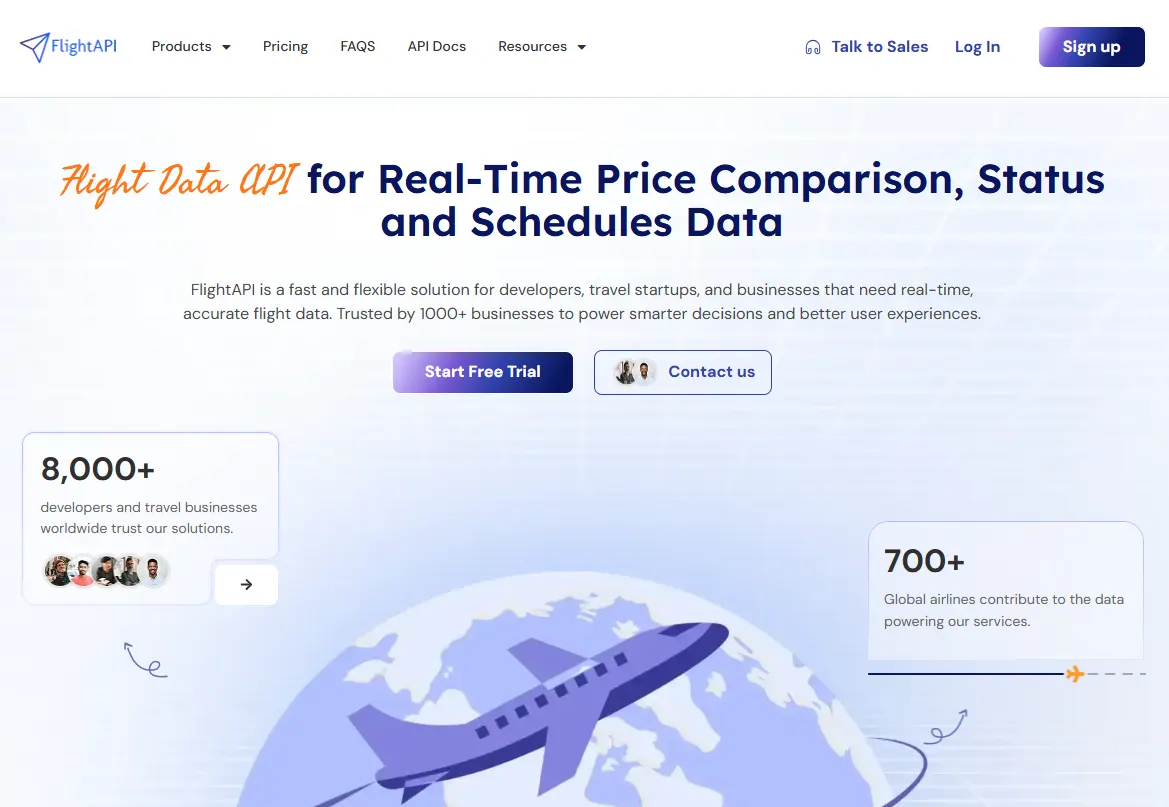
FlightAPI provides a set of REST APIs that deliver live flight data, fare pricing, tracking, and airport schedules. It aggregates information from more than 700 airlines and online travel agencies, offering developers reliable and real-time access to flight data worldwide.
Its core APIs include:
- Flight Price API – fetches real-time fare quotes for one-way, round-trip, or multi-city itineraries. It returns details like airline name, flight number, timings, duration, baggage allowance, route, and total fare (with tax breakdown). The results include booking links and support for multiple currencies.
- Flight Tracking API – lets you track any flight globally. You get scheduled and actual departure or arrival times, terminal and gate details, and live flight status updates. You can track flights by route or by flight number, even up to a year in advance. Want to go deeper? Check out the leading flight status APIs we’ve highlighted in this blog.
- Airport Schedule API – returns complete arrival or departure schedules for any airport, with live status, gate, and terminal information. If you don’t specify a day, the API returns schedules covering a 10-day range from the last 5 days to the next 5.
To know more, head over to the docs.
Why Developers Like It
FlightAPI.io is easy to get started with, making it suitable for everyone from independent developers to large enterprises. It delivers comprehensive data in clean JSON format, backed by clear documentation and responsive support. The platform’s real-time updates and global reach make it a strong alternative for projects focused on flight search, pricing, or analytics.
We also have some tutorials you can check out if you need to do the same:
No-Code Integration for Non-Developers
Even if you’re not a developer, and need flight data. FlightAPI works smoothly with automation tools like Make (Integromat), Zapier, Google Apps Script, and n8n, and allows you to fetch, monitor, or log flight data without writing a single line of code.
Here are tutorials designed for non-developers:
- Track Flights Between Airports With Google Sheet
- Automate Flight Status Tracking With Google Sheet
- Create a Flight Tracking Tool With Loveable
With these tools, you can integrate FlightAPI.io into your daily workflow to track flights, analyze prices, or display schedules, all without technical setup or backend development.
Pros
- Pricing, tracking, and airport data available in one platform.
- Real-time updates sourced from 700+ airlines.
- Multi-currency support and global coverage.
- Simple JSON responses and straightforward documentation.
Cons
- Credit-based billing means costs can scale with higher usage.
- No built-in booking or payment processing.
- Some advanced features (multi-city search, high concurrency) are limited to higher plans.
Pricing
- A free trial includes 20 API calls.
- Lite plan: $49/month with 30,000 credits and up to 5 concurrent requests.
- Standard plan: $99/month with 100,000 credits and up to 10 concurrent requests.
- Plus plan: $199/month with 500,000 credits and up to 50 concurrent requests. Click here to check out the detailed pricing.
2. AirLabs Data API
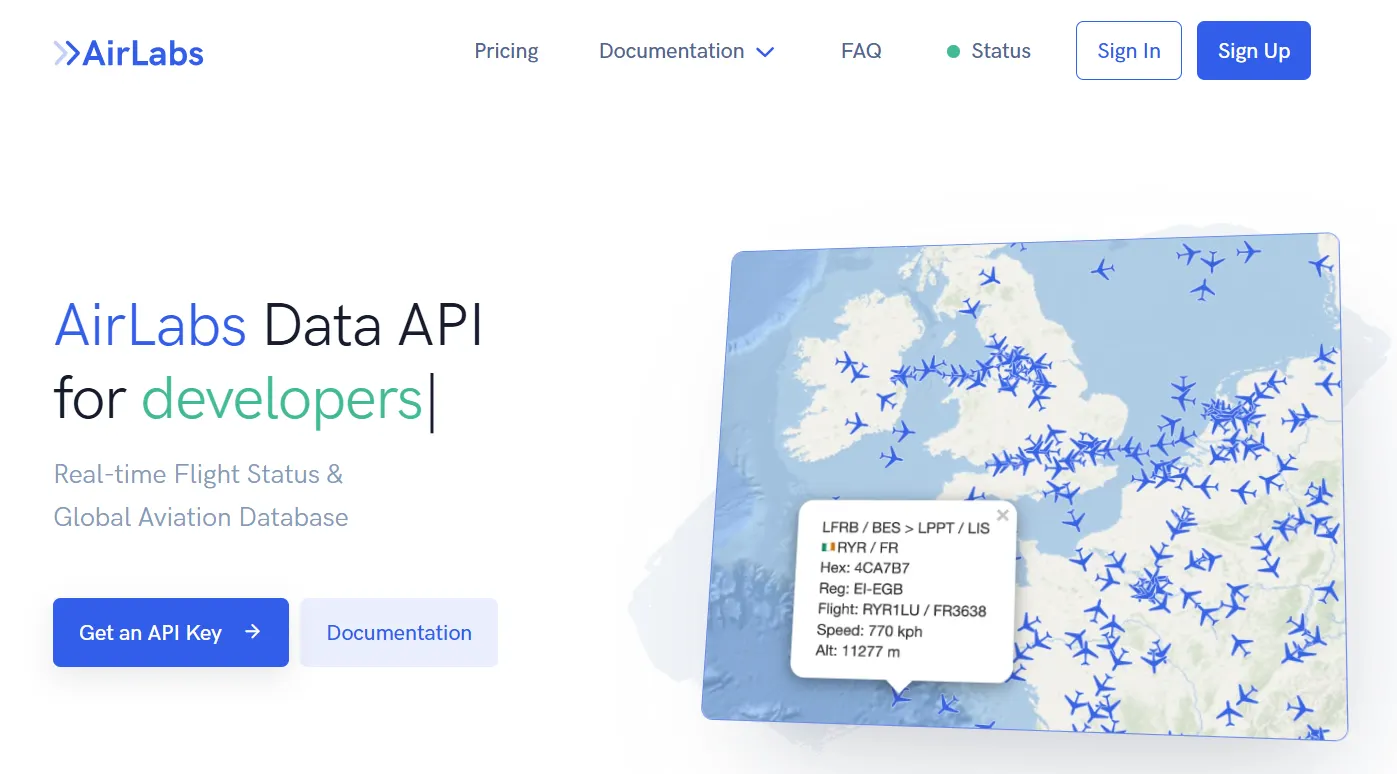
AirLabs Data API brings together static aviation databases and real-time flight information through a single, developer-friendly interface. It covers airports, airlines, fleets, cities, and routes, all with IATA and ICAO codes, names, coordinates, and related metadata.
On the live side, it delivers up-to-the-second flight status updates, including departures, arrivals, delays, gates, and terminals. Developers can also use endpoints for autocomplete search, nearby airport lookup, and flight alerts via webhooks.
Responses can be formatted in JSON, XML, or CSV, and the documentation includes clear examples for every endpoint.
Why Developers Use It
AirLabs is ideal for developers who want reliable, global aviation data without managing multiple providers. The combination of clean data sets, live tracking, and extra endpoints makes it suitable for travel platforms, analytics tools, or flight-tracking dashboards.
Pros
- Access to global airport, airline, fleet, and route data.
- Real-time flight status and schedule updates.
- Multiple output formats: JSON, XML, and CSV.
- Straightforward documentation and code samples.
- Flexible pricing with a usable free plan.
Cons
- Does not include fare pricing, only provides operational and flight data.
- Webhook setup can be a bit advanced for smaller teams.
- Higher query limits and alert endpoints are available on premium plans.
Pricing
Free Plan – $0/month, around 1,000 queries.
Developer Plan – $49/month, 25,000 queries.
Business Plan – $99/month, 100,000 queries.
Enterprise Plan – $499/month, 1,000,000 queries, and priority support.
3. AviationStack
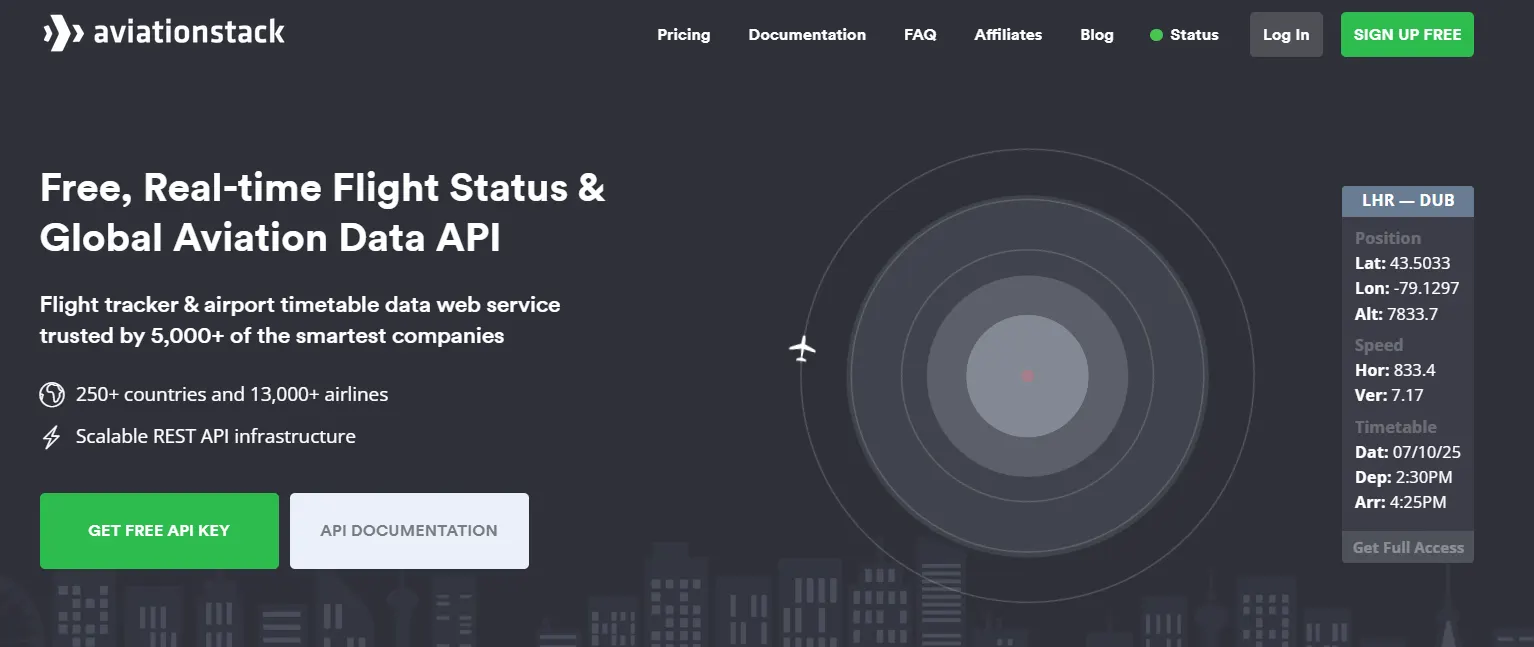
AviationStack is a REST API built for real-time and historical flight tracking. It delivers global coverage, updating flight status every 30 to 60 seconds, which is fast enough for live dashboards or booking platforms that need accurate data without lag.
The API includes information on flights, airlines, airports, and aircraft across 250+ countries. It covers more than 10,000 airports, 13,000 airlines, 19,000 aircraft, and 9,000 cities, providing both live and past flight records.
Because it’s built on a scalable cloud infrastructure, developers can use Aviationstack for travel apps, flight tracking tools, logistics dashboards, or analytics systems that rely on historical trends and real-time data.
Why Developers Use It
Aviationstack stands out for its balance of speed, global reach, and simplicity. The endpoints are clear, responses are easy to parse in JSON format, and the documentation is beginner-friendly. It’s a strong fit for anyone who needs continuous flight updates without wrestling with complex setup steps.
Pros
- Real-time and historical flight data with broad global coverage.
- Updates every 30 – 60 seconds, suitable for live tracking systems.
- Clean REST API with simple integration and clear docs.
- Flexible pricing options, including a free plan for testing.
Cons
- Aggregated data from multiple sources can occasionally create minor inconsistencies.
- Handling errors for advanced integrations may need extra debugging effort.
Pricing
- Free Plan – $0/month, 100 requests with full aviation data and real-time flights.
- Basic Plan – $44.99/month, 10,000 requests with standard support and commercial license.
- Professional Plan – $131.99/month, 50,000 requests, extended features including airline routes, autocomplete, and future flight data.
Aviationstack is fast, reliable, and scalable, ideal for developers who want real-time flight visibility and historical insights without overcomplicating their setup.
4. Amadeus

Amadeus offers a Self-Service API platform designed for developers and startups that need access to flight, pricing, booking, and airport data without the heavy contracts associated with traditional GDS systems.
For flight pricing, two key endpoints stand out:
- Flight Offers Search – Lets you find available flights and fare options between airports.
- Flight Offers Price – Confirms real-time availability and provides final pricing, including taxes, fees, and fare rules.
Developers can work in a sandbox environment for free testing with sample data, then move to production for live results. The platform runs on a quota-based, pay-as-you-go model, meaning you get a free monthly allowance and pay only for extra API calls.
Pros
- Backed by a trusted global provider with high data accuracy and stable infrastructure.
- Clean documentation, active developer support, and clear endpoint structure for quick integration.
Cons
- Access can be difficult. Production approval often requires verification and compliance review.
- No public fare rates are listed per call, which makes pricing estimation tricky.
- Only public GDS fares are available in Self-Service, not negotiated or private deals.
Pricing
- Free sandbox access with limited monthly requests.
- Production retains a free quota; additional usage is billed per API call.
- Official pricing is not published publicly and varies by endpoint.
5. Aviation Edge
Aviation Edge provides an all-in-one aviation data platform that combines multiple APIs under one subscription. Their suite includes flight tracking, schedules, routes, delays, future schedules, and detailed static databases for airlines, airports, and aircraft.
The highlight is their Flight Ticket Prices API, which returns fare options based on departure and arrival IATA codes, travel dates, and trip type (one-way or round-trip). Results include airline names, flight timings, layovers, baggage details, and total prices. According to their official documentation, the API gathers fare data from over 400 airlines, helping users find affordable flight options with minimal setup.
Other APIs like the Schedules API, Flight Tracker API, and Airline Routes API complement pricing data, giving developers access to a complete aviation data ecosystem for applications in travel search, logistics, or analytics.
Why Developers Use It
Aviation Edge is popular with teams that want both fare pricing data and operational flight information in a single place. It simplifies integration by offering one subscription for multiple endpoints, making it practical for startups or companies building scalable aviation-based applications.
Pros
- Transparent, published pricing across standard plans.
- Full aviation data suite included flight pricing, schedules, tracking, and static datasets all in one platform.
Cons
- Regular plans start at $299/month, which can be expensive for small projects.
- The discounted “first-month” offer (as low as $15, $29, or $79) applies only once before auto-renewing at regular rates.
- Some users have raised concerns about auto-renewal and billing clarity on third-party review sites (not officially from Aviation Edge).
Pricing
Developer Plan – $299/month (discounted first month at $15–$79).
Business Plan – $599/month.
Business Gold Plan – $1,499/month.
All plans renew monthly and include access to their full API suite with fixed API call limits.
Wrapping Up:
Each of these Sabre API alternatives has its own strengths. Some focus on fare pricing, others on live tracking or complete aviation datasets. The right choice depends on what you’re building and how deep your data needs to go.
If you’re a startup or developer looking for quick integration and transparent pricing, FlightAPI.io will be a solid fit. For larger-scale or data-heavy projects, Amadeus, AirLabs, Aviation Edge, and AviationStack offer broader coverage and enterprise-ready tools.
Take a closer look at each option, compare features, and choose the one that best fits your workflow and budget.