AviationStack vs FlightAPI: Which Flight Status API Should You Choose?

AviationStack vs FlightAPI: Which Flight Status API Should You Choose?

Both AviationStack and FlightAPI are popular choices for developers who need flight status and tracking data.  If you are looking for the same, this guide compares both APIs so you can understand what they offer before integrating one into your project. In this blog post, I have broken down the important details of each API. We will look at the type of data points they return, how their endpoints work, and what features they provide that may matter during development. Things like flight status coverage, request limits, and ease of integration can affect how smoothly your application works once it goes live. Let’s get started with FlightAPI.  FlightAPI FlightAPI provides APIs that allow developers to retrieve flight status and tracking information.  For this use case, it mainly offers two endpoints. One allows you to track a specific flight using the airline code and flight number. The other lets you check flights operating between two airports on a specific date. Both APIs return structured JSON responses, so the data can easily be parsed and displayed inside travel platforms, airport dashboards, or tracking tools. Data Returned Since FlightAPI provides two APIs for flight status and tracking, the type of data returned depends on the endpoint being used. 1. Flight Tracking API This flight tracking API tracks a specific flight using its airline code and flight number. The response contains detailed departure and arrival information for that flight. Common fields returned include: The response separates departure and arrival objects, which makes it easier to extract and display the data in flight tracking interfaces.  To know more about the endpoint, parameters, and the response, check out the documentation.  2. Track Flights Between Airports API The second API allows you to track flights operating between two airports on a specific date. Instead of returning a single flight, this endpoint returns a list of flights scheduled on that route. Typical fields returned include: This endpoint is useful when you want to display all flights operating between two airports rather than tracking just one flight. Explore the documentation page to know more.  Speed and Integration Both APIs follow a simple request structure. Developers only need to send a GET request with the required parameters, and the API returns the flight data in JSON format with lightning speed.  Plus, the responses are structured and lightweight; they can be easily parsed in backend environments such as Node.js, Python, or other server-side languages.  Pricing Best for FlightAPI is a good option for projects that need simple flight status and tracking data. It can be used for ⬇️ If you prefer no-code tools, you can still integrate FlightAPI and export flight tracking data without writing any code.  Below are a few step-by-step tutorials that show how to build simple flight tracking workflows using popular tools ⬇️ AviationStack AviationStack provides a REST API that allows developers to retrieve real-time flight status and aviation data. For flight tracking and status use cases, the API mainly relies on the Flights API and the Airport Timetable API. Unlike some APIs that provide a dedicated flight tracking endpoint, AviationStack uses multiple endpoints depending on the type of query.  For example, you can retrieve the status of a specific flight using filters in the Flights API, while airport arrival and departure boards are retrieved using the Timetable API. Endpoints return structured JSON responses, which makes the data easy to parse and integrate into travel platforms, airport dashboards, or flight monitoring tools. Data Returned Since AviationStack provides multiple endpoints across its aviation dataset, the response depends on which endpoint you use for flight status and tracking. Below are the main endpoints developers use when retrieving flight status data. 1. Flights API  Endpoint: https://api.aviationstack.com/v1/flights This endpoint returns real-time flight status information and can also return historical flight data depending on the plan. Developers can filter results using parameters such as flight number, airline, departure airport, arrival airport, or flight status, which makes it possible to track specific flights. Common fields returned include: The response separates airline, flight, departure, and arrival objects, which makes it easier to extract flight information inside applications. 2. Flight Schedules API  Endpoint: https://api.aviationstack.com/v1/flight_schedules This endpoint returns scheduled flights for airports or routes. Instead of returning a single flight, this endpoint returns a list of flights scheduled to arrive or depart from an airport, which makes it useful for building airport arrival or departure boards. Typical fields returned include: This endpoint is commonly used for airport schedule dashboards or arrival/departure boards. 3. Future Flight Schedules API Endpoint: https://api.aviationstack.com/v1/flightsFuture This endpoint allows developers to retrieve future scheduled flights. It is mainly used by applications that need to analyze or track upcoming flights for a specific airport or route. Typical fields returned include: This endpoint helps developers build tools that require future flight planning or schedule monitoring. Speed and Integration These APIs are in standard REST request structure, so developers can retrieve flight data by sending a simple HTTP GET request. Responses are returned in JSON format, which makes them easy to parse in backend environments such as Node.js, Python, PHP, or other server-side languages. Real-time flight status updates are typically delayed by around 30–60 seconds, which is considered average in the industry.  Pricing Best for Projects that need detailed flight status data along with airport-level schedules. Typical use cases include: Final Verdict Both AviationStack and FlightAPI are solid APIs for retrieving flight status and tracking data. The right choice depends on how much data you need and how complex your integration is. You can explore more options in our blog on the best flight status APIs. If your goal is to track flights quickly and integrate the data with minimal setup, FlightAPI is usually the better option. It provides focused endpoints for tracking a flight by number or retrieving flights between airports.  The responses are lightweight, integration is straightforward, and the pricing is more economical for higher request volumes.  For most developer use cases like travel apps, tracking dashboards, or logistics tools, FlightAPI already returns the
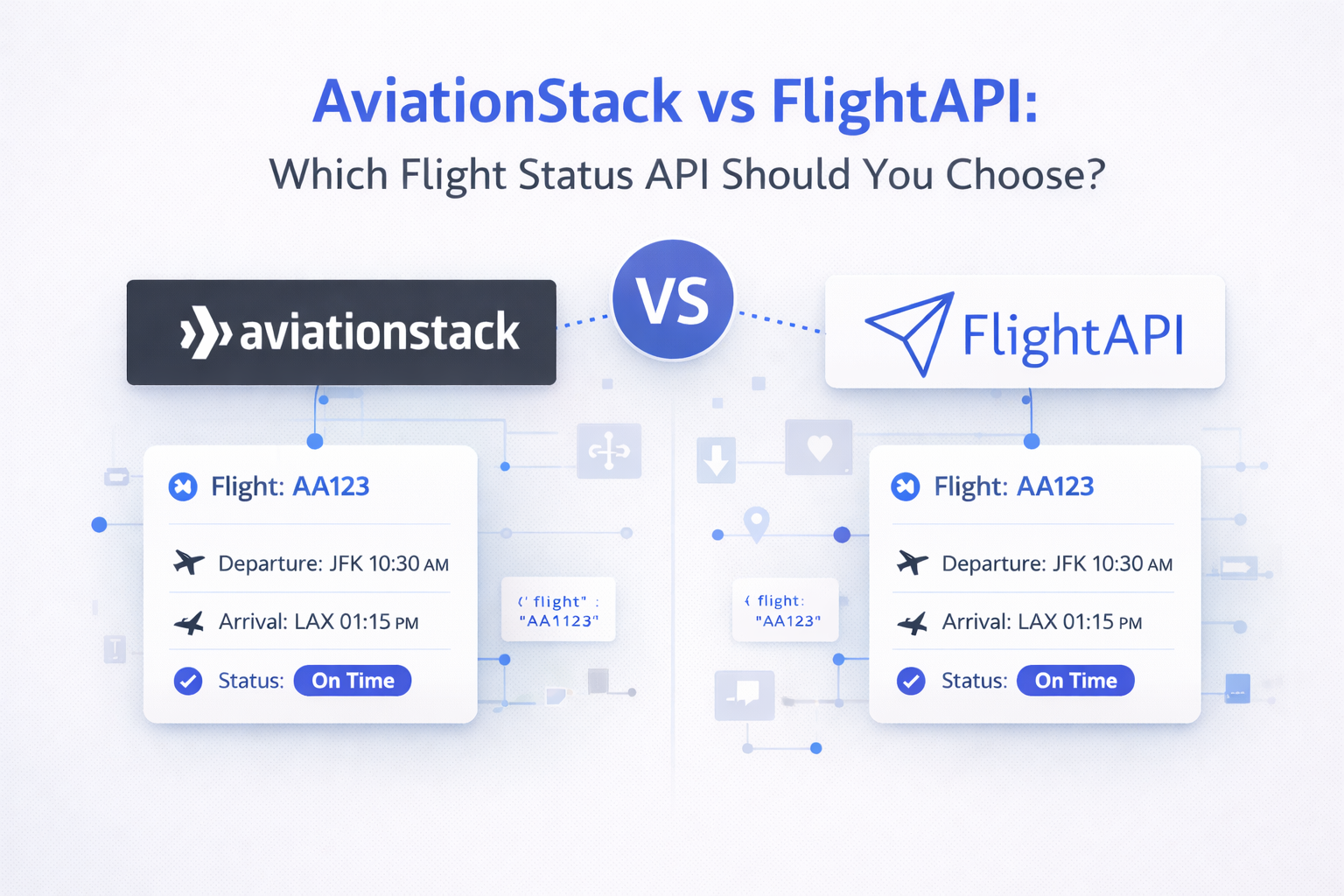
Both AviationStack and FlightAPI are popular choices for developers who need flight status and tracking data. 

If you are looking for the same, this guide compares both APIs so you can understand what they offer before integrating one into your project.

In this blog post, I have broken down the important details of each API. We will look at the type of data points they return, how their endpoints work, and what features they provide that may matter during development.

Things like flight status coverage, request limits, and ease of integration can affect how smoothly your application works once it goes live.

Let’s get started with FlightAPI. 

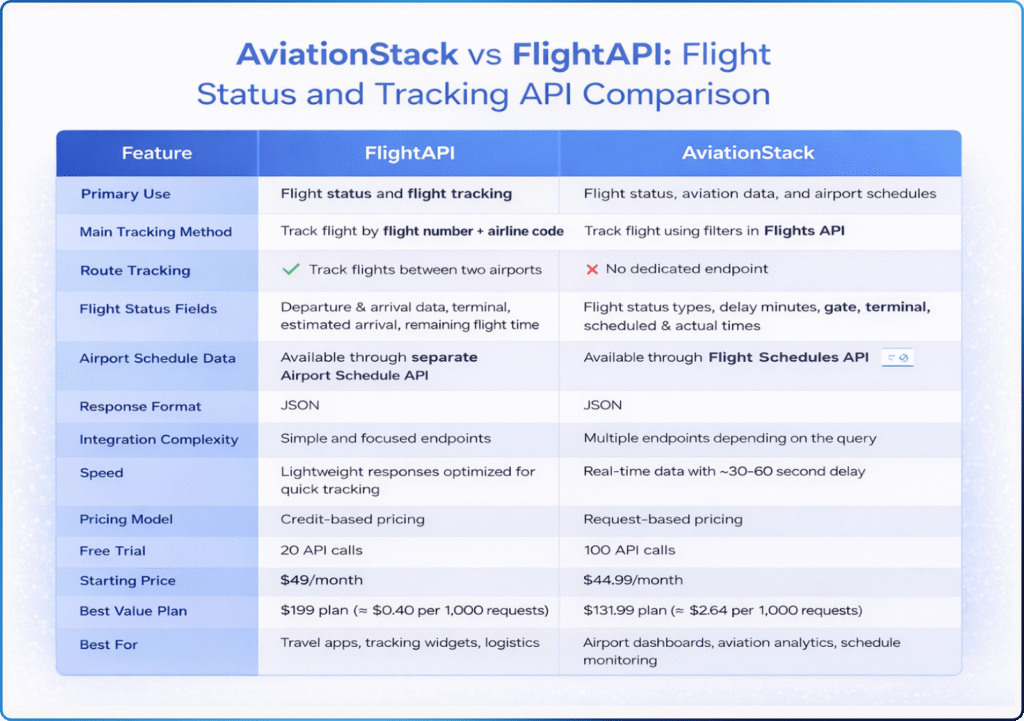
AviationStack vs FlightAPI Comparison

FlightAPI

FlightAPI provides APIs that allow developers to retrieve flight status and tracking information

For this use case, it mainly offers two endpoints. One allows you to track a specific flight using the airline code and flight number. The other lets you check flights operating between two airports on a specific date.

Both APIs return structured JSON responses, so the data can easily be parsed and displayed inside travel platforms, airport dashboards, or tracking tools.

Data Returned

Since FlightAPI provides two APIs for flight status and tracking, the type of data returned depends on the endpoint being used.

1. Flight Tracking API

This flight tracking API tracks a specific flight using its airline code and flight number. The response contains detailed departure and arrival information for that flight.

Common fields returned include:

  • departure airport and airport code
  • arrival airport and airport code
  • airport city and country code
  • terminal information
  • scheduled departure time
  • estimated arrival time
  • actual takeoff time
  • remaining flight time

The response separates departure and arrival objects, which makes it easier to extract and display the data in flight tracking interfaces. 

To know more about the endpoint, parameters, and the response, check out the documentation

2. Track Flights Between Airports API

The second API allows you to track flights operating between two airports on a specific date. Instead of returning a single flight, this endpoint returns a list of flights scheduled on that route.

Typical fields returned include:

  • airline name
  • flight number
  • flight status
  • departure time
  • arrival time
  • operating airline information

This endpoint is useful when you want to display all flights operating between two airports rather than tracking just one flight. Explore the documentation page to know more. 

Speed and Integration

Both APIs follow a simple request structure. Developers only need to send a GET request with the required parameters, and the API returns the flight data in JSON format with lightning speed. 

Plus, the responses are structured and lightweight; they can be easily parsed in backend environments such as Node.js, Python, or other server-side languages. 

Pricing

  • Monthly credit-based pricing model
  • Free trial available with 20 free API calls for testing
  • Pricing starts at $49 per month
  • CPM (based on the $199 plan) is $0.40 per request, which makes it relatively affordable for higher-volume usage

Best for

FlightAPI is a good option for projects that need simple flight status and tracking data. It can be used for ⬇️

  • Flight tracking widgets
  • Travel applications showing live flight updates
  • Airport dashboard displays
  • Logistics platforms monitoring flights
  • Tools that need to track flights between two airports

If you prefer no-code tools, you can still integrate FlightAPI and export flight tracking data without writing any code. 

Below are a few step-by-step tutorials that show how to build simple flight tracking workflows using popular tools ⬇️

AviationStack

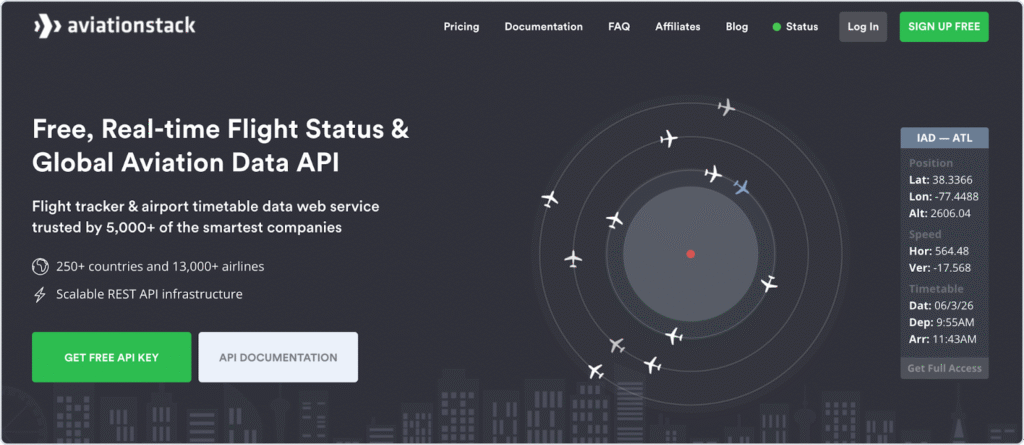
AviationStack provides a REST API that allows developers to retrieve real-time flight status and aviation data. For flight tracking and status use cases, the API mainly relies on the Flights API and the Airport Timetable API.

Unlike some APIs that provide a dedicated flight tracking endpoint, AviationStack uses multiple endpoints depending on the type of query

For example, you can retrieve the status of a specific flight using filters in the Flights API, while airport arrival and departure boards are retrieved using the Timetable API.

Endpoints return structured JSON responses, which makes the data easy to parse and integrate into travel platforms, airport dashboards, or flight monitoring tools.

Data Returned

Since AviationStack provides multiple endpoints across its aviation dataset, the response depends on which endpoint you use for flight status and tracking.

Below are the main endpoints developers use when retrieving flight status data.

1. Flights API 

Endpoint: https://api.aviationstack.com/v1/flights

This endpoint returns real-time flight status information and can also return historical flight data depending on the plan.

Developers can filter results using parameters such as flight number, airline, departure airport, arrival airport, or flight status, which makes it possible to track specific flights.

Common fields returned include:

  • flight date
  • flight status (scheduled, active, landed, cancelled, incident, diverted)
  • airline name and airline code
  • flight number
  • departure airport and airport code
  • arrival airport and airport code
  • scheduled departure time
  • estimated departure time
  • actual departure time
  • departure delay minutes
  • scheduled arrival time
  • estimated arrival time
  • actual arrival time
  • arrival delay minutes
  • terminal and gate information

The response separates airline, flight, departure, and arrival objects, which makes it easier to extract flight information inside applications.

2. Flight Schedules API 

Endpoint: https://api.aviationstack.com/v1/flight_schedules

This endpoint returns scheduled flights for airports or routes.

Instead of returning a single flight, this endpoint returns a list of flights scheduled to arrive or depart from an airport, which makes it useful for building airport arrival or departure boards.

Typical fields returned include:

  • airline name
  • flight number
  • departure airport
  • arrival airport
  • scheduled departure time
  • estimated departure time
  • scheduled arrival time
  • estimated arrival time

This endpoint is commonly used for airport schedule dashboards or arrival/departure boards.

3. Future Flight Schedules API

Endpoint: https://api.aviationstack.com/v1/flightsFuture

This endpoint allows developers to retrieve future scheduled flights.

It is mainly used by applications that need to analyze or track upcoming flights for a specific airport or route.

Typical fields returned include:

  • airline name
  • flight number
  • departure airport
  • arrival airport
  • scheduled departure time
  • scheduled arrival time

This endpoint helps developers build tools that require future flight planning or schedule monitoring.

Speed and Integration

These APIs are in standard REST request structure, so developers can retrieve flight data by sending a simple HTTP GET request.

Responses are returned in JSON format, which makes them easy to parse in backend environments such as Node.js, Python, PHP, or other server-side languages.

Real-time flight status updates are typically delayed by around 30–60 seconds, which is considered average in the industry. 

Pricing

  • Monthly request-based pricing model
  • Free plan with 100 API requests for testing
  • Pricing starts at $44.99 per month
  • The CPM (based on the best-selling Professional plan) costs $131.99, which averages out to $2.64 per unit. 

Best for

Projects that need detailed flight status data along with airport-level schedules. Typical use cases include:

  • Flight tracking dashboards
  • Travel applications displaying flight status
  • Airport arrival and departure boards
  • Aviation analytics tools that analyze delay minutes or status changes
  • Airline or airport monitoring platforms that track scheduled and estimated flight times

Final Verdict

Both AviationStack and FlightAPI are solid APIs for retrieving flight status and tracking data. The right choice depends on how much data you need and how complex your integration is. You can explore more options in our blog on the best flight status APIs.

If your goal is to track flights quickly and integrate the data with minimal setup, FlightAPI is usually the better option. It provides focused endpoints for tracking a flight by number or retrieving flights between airports. 

The responses are lightweight, integration is straightforward, and the pricing is more economical for higher request volumes. 

For most developer use cases like travel apps, tracking dashboards, or logistics tools, FlightAPI already returns the core data needed. Sign up for FlightAPI today to start testing.

AviationStack, on the other hand, provides more detailed aviation datasets, such as flight delay minutes, broader status categories, and airport schedule data. If your project specifically requires those extra data points or deeper aviation analytics, AviationStack may be a better fit.

Related Blogs

Read more articles to stay informed and explore related topics.