Flight API Statistics and Trends 2026

Flight API Statistics and Trends 2026

The airline industry is constantly evolving, but the data associated with it doesn’t always keep pace. Delay figures, API market sizes, passenger numbers, and AI adoption rates across airlines are scattered across paywalled reports and outdated press releases. Getting a clear picture of where flight APIs actually stand in 2026 takes time, even with AI search, because the results aren’t always accurate or complete. That’s why I researched, fact-checked, and put everything together in one place. This piece covers everything from the flight API market size and growth to what’s shaping the industry through the rest of 2026. Let’s go. The Flight Data API Market: Size and Growth The flight data API market has moved from a niche developer tool to a core layer in aviation infrastructure. But measuring its exact size isn’t straightforward. Different research firms define the market differently. Some focus only on flight status and tracking APIs. Others include broader aviation data services like pricing, analytics, and operational intelligence. That’s why the numbers don’t always line up. What does line up is the trajectory. Growth is consistent across every dataset. According to Verified Market Reports, the flight data API market was valued at USD 1.52 billion in 2024 and is projected to reach USD 4.67 billion by 2033, growing at a CAGR of 13.5% between 2026 and 2033. Other estimates sit in a similar range but differ slightly in scope. Business Research Insights  Flight Data API Market places the market at USD 1.65 billion in 2026, reaching USD 3.29 billion by 2035, with a CAGR of 8.2%. While market definitions vary across reports, the overall growth trajectory remains consistent. What’s Driving Its Growth The shift toward APIs is already evident in airline operations, with adoption moving beyond early experimentation into core usage. Source: Business Research Insights aviation API report These figures reflect a broader structural shift in aviation. Airlines now operate in real time, where delays, pricing, routing, and passenger updates depend on continuous data exchange. APIs enable this without requiring complete system rebuilds. At the same time, cloud adoption is accelerating deployment and scalability, making it easier to integrate new data sources. The growing travel tech ecosystem, including aggregators and third-party platforms, is further increasing demand for structured flight data. In addition, data is becoming a strategic asset. Airlines are using it not only for operations but also to optimize pricing, route efficiency, and customer experience, reinforcing the role of APIs as a foundational layer in modern aviation systems. The Biggest Barrier to Adoption Despite strong market growth, adoption remains uneven across the aviation industry, with integration challenges acting as the primary constraint rather than a lack of demand. Key limitations across airlines: These constraints highlight a structural divide in the market. Larger airlines, supported by stronger infrastructure and budgets, are scaling API usage across operations. In contrast, smaller carriers and legacy systems face slower adoption cycles due to compatibility and cost limitations, rather than a lack of strategic intent. Where the Market Stands The flight data API market is transitioning into a foundational layer within aviation systems, with adoption already widespread among major airlines. Current market position: While market estimates vary depending on how the segment is defined, the overall direction remains consistent. APIs are increasingly becoming the standard method for data exchange across aviation systems, with their role expected to strengthen further as the industry continues to prioritize real-time operations and data-driven decision-making. Flight Data Providers for Core Data Needs As aviation systems become more data-driven, most applications depend on a consistent set of core data points. Across booking platforms, tracking tools, and internal systems, the primary needs remain the same – accurate pricing, real-time flight status, and reliable schedule data. To meet these needs, there are multiple flight data providers available, each offers different datasets and levels of coverage. However, for teams looking to access pricing, status, and schedule data through a single integration, platforms like FlightAPI bring these core data points together in one place. Explore the dedicated APIs and the data points👇 Flight Price API delivers real-time fare data across routes, supporting one-way, round-trip, and multi-city searches. It aggregates pricing from multiple airlines and vendors, returning structured details such as airline, route segments, duration, and fare breakdowns that make it suitable for booking engines and comparison platforms. Flight Status API provides live operational updates, including departure and arrival times, delays, cancellations, and flight progress. It also includes details like terminal and gate information where available, helping systems stay aligned with actual flight movements. Airport Schedule API offers structured data on arrivals, departures, routes, and timings across airports. This acts as a base layer for search, route mapping, and planning systems. Sign up to test these APIs and get 20 free credits. If you’re looking for additional travel data, I’ve put together a detailed roundup of tested Travel API providers for flights, hotels, and more. Aviation Demand Metrics For Passenger Growth and Capacity Trends Flight API usage is directly tied to how active and complex the aviation industry is at any given time. More passengers, higher load factors, and tighter schedules don’t just increase traffic; they increase the need for real-time coordination across systems. The current data shows that aviation demand is not just recovering, it is stabilizing at high levels. Global Passenger Demand The combination of rising demand + high load factors means airlines are operating closer to capacity limits. There’s less room for inefficiencies, which increases reliance on real-time systems to manage disruptions, pricing, and scheduling. Early 2026 Trends Source: IATA – Air Passenger Market Analysis (March 2026)Source: SITA Air Transport IT Insights Growth is continuing, but at a more controlled pace compared to the recovery years. That shift is important. It signals a move from rapid rebound to operational stability, where efficiency and optimization become more important than raw expansion. Again, both depend on structured and real-time data access. Peak Demand and Capacity Source: OAG – Airline Capacity Statistics The gap between peak and low-capacity days highlights how

The airline industry is constantly evolving, but the data associated with it doesn’t always keep pace.

Delay figures, API market sizes, passenger numbers, and AI adoption rates across airlines are scattered across paywalled reports and outdated press releases.

Getting a clear picture of where flight APIs actually stand in 2026 takes time, even with AI search, because the results aren’t always accurate or complete.

That’s why I researched, fact-checked, and put everything together in one place.

This piece covers everything from the flight API market size and growth to what’s shaping the industry through the rest of 2026.

Let’s go.

The Flight Data API Market: Size and Growth

The flight data API market has moved from a niche developer tool to a core layer in aviation infrastructure. But measuring its exact size isn’t straightforward.

Different research firms define the market differently. Some focus only on flight status and tracking APIs. Others include broader aviation data services like pricing, analytics, and operational intelligence. That’s why the numbers don’t always line up.

What does line up is the trajectory. Growth is consistent across every dataset.

According to Verified Market Reports, the flight data API market was valued at USD 1.52 billion in 2024 and is projected to reach USD 4.67 billion by 2033, growing at a CAGR of 13.5% between 2026 and 2033.

Other estimates sit in a similar range but differ slightly in scope. Business Research Insights  Flight Data API Market places the market at USD 1.65 billion in 2026, reaching USD 3.29 billion by 2035, with a CAGR of 8.2%.

While market definitions vary across reports, the overall growth trajectory remains consistent.

What’s Driving Its Growth

The shift toward APIs is already evident in airline operations, with adoption moving beyond early experimentation into core usage.

  • 76% of airlines globally rely on APIs for real-time monitoring and operational accuracy
  • 67% of deployments are cloud-based, compared to 33% on-premises
  • 63% of API demand comes from North America and Europe
  • 22% of aviation software firms have expanded their API portfolios

Source: Business Research Insights aviation API report

These figures reflect a broader structural shift in aviation. Airlines now operate in real time, where delays, pricing, routing, and passenger updates depend on continuous data exchange. APIs enable this without requiring complete system rebuilds.

At the same time, cloud adoption is accelerating deployment and scalability, making it easier to integrate new data sources. The growing travel tech ecosystem, including aggregators and third-party platforms, is further increasing demand for structured flight data.

In addition, data is becoming a strategic asset. Airlines are using it not only for operations but also to optimize pricing, route efficiency, and customer experience, reinforcing the role of APIs as a foundational layer in modern aviation systems.

The Biggest Barrier to Adoption

Despite strong market growth, adoption remains uneven across the aviation industry, with integration challenges acting as the primary constraint rather than a lack of demand.

Key limitations across airlines:

  • 42% of airlines face budget or infrastructure constraints when adopting advanced API systems (Source)
  • 41.7% of small carriers encounter financial barriers when integrating modern aviation technologies (Source
  • 36.4% of legacy systems lack compatibility with modern API frameworks (Source)

These constraints highlight a structural divide in the market. Larger airlines, supported by stronger infrastructure and budgets, are scaling API usage across operations. In contrast, smaller carriers and legacy systems face slower adoption cycles due to compatibility and cost limitations, rather than a lack of strategic intent.

Where the Market Stands

The flight data API market is transitioning into a foundational layer within aviation systems, with adoption already widespread among major airlines.

Current market position:

  • Adoption is widely established across large and mid-sized airlines
  • Cloud infrastructure is accelerating integration and scalability
  • Demand remains concentrated in North America and Europe, while expanding globally
  • Legacy systems continue to be the primary friction point for adoption

While market estimates vary depending on how the segment is defined, the overall direction remains consistent. APIs are increasingly becoming the standard method for data exchange across aviation systems, with their role expected to strengthen further as the industry continues to prioritize real-time operations and data-driven decision-making.

Flight Data Providers for Core Data Needs

As aviation systems become more data-driven, most applications depend on a consistent set of core data points. Across booking platforms, tracking tools, and internal systems, the primary needs remain the same – accurate pricing, real-time flight status, and reliable schedule data.

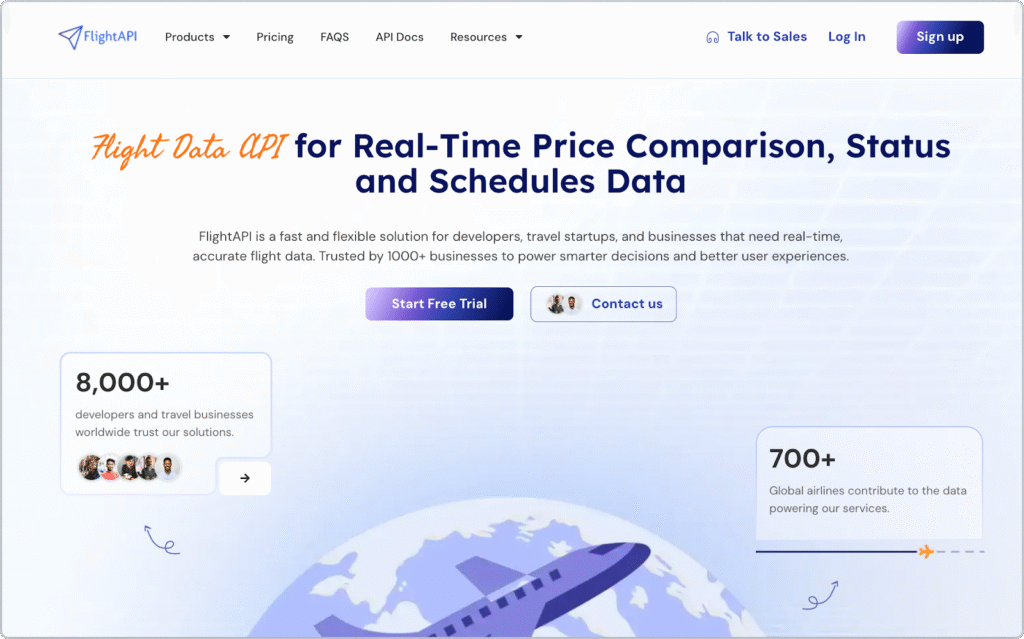
To meet these needs, there are multiple flight data providers available, each offers different datasets and levels of coverage. However, for teams looking to access pricing, status, and schedule data through a single integration, platforms like FlightAPI bring these core data points together in one place.

Explore the dedicated APIs and the data points👇

Flight Price API delivers real-time fare data across routes, supporting one-way, round-trip, and multi-city searches. It aggregates pricing from multiple airlines and vendors, returning structured details such as airline, route segments, duration, and fare breakdowns that make it suitable for booking engines and comparison platforms.

Flight Status API provides live operational updates, including departure and arrival times, delays, cancellations, and flight progress. It also includes details like terminal and gate information where available, helping systems stay aligned with actual flight movements.

Airport Schedule API offers structured data on arrivals, departures, routes, and timings across airports. This acts as a base layer for search, route mapping, and planning systems.

Sign up to test these APIs and get 20 free credits.

If you’re looking for additional travel data, I’ve put together a detailed roundup of tested Travel API providers for flights, hotels, and more.

Flight API usage is directly tied to how active and complex the aviation industry is at any given time. More passengers, higher load factors, and tighter schedules don’t just increase traffic; they increase the need for real-time coordination across systems.

The current data shows that aviation demand is not just recovering, it is stabilizing at high levels.

Global Passenger Demand

  • 9.8 billion passengers projected in 2025, reflecting 3.7% year-on-year growth (source)
  • International traffic expected to grow 5.3%, compared to 2.4% for domestic travel (source)
  • RPKs increased by 5.3% in 2025 vs 2024
  • ASKs rose by 5.2% in 2025
  • Passenger Load Factor reached 83.6%, a record high
  • International demand increased by 7.1%, with a load factor at 83.5% (source)

The combination of rising demand + high load factors means airlines are operating closer to capacity limits. There’s less room for inefficiencies, which increases reliance on real-time systems to manage disruptions, pricing, and scheduling.

  • Global demand increased 3.8% in January 2026 vs January 2025
  • Load factor reached 82.0%, a record for January
  • International demand grew 5.9%, with a load factor at 82.5%
  • Passenger traffic forecast to grow 4.9% in 2026 (RPK basis)

Source: IATA – Air Passenger Market Analysis (March 2026)
Source: SITA Air Transport IT Insights

Growth is continuing, but at a more controlled pace compared to the recovery years.

That shift is important. It signals a move from rapid rebound to operational stability, where efficiency and optimization become more important than raw expansion. Again, both depend on structured and real-time data access.

Peak Demand and Capacity

  • 19,833,642 seats on 1 August 2025, the highest daily capacity recorded
  • Surpassed 2024’s peak by over 555,000 seats
  • Lowest daily capacity: 15,200,778 seats on 28 January 2025

Source: OAG – Airline Capacity Statistics

The gap between peak and low-capacity days highlights how uneven demand can be.

For airlines, this creates constant fluctuations in scheduling, pricing, and availability. Managing these fluctuations requires systems that can respond in real time, which directly increases reliance on APIs for data synchronization across platforms.

Why This Matters for Flight APIs

Taken together, these trends point to a more complex operating environment.

  • Higher passenger volumes increase the number of data touchpoints
  • High load factors reduce tolerance for delays and inefficiencies
  • Regional growth differences introduce variability
  • Demand fluctuations require real-time adjustments

All of this increases the volume, frequency, and importance of data exchange across systems. Flight APIs sit at the center of this shift, acting as the layer that connects booking systems, tracking platforms, pricing engines, and operational tools in real time.

Flight APIs are now used across multiple layers of the travel stack, from flight status to booking flows, automation, and real-time operations. The shift in 2026 is not new use cases, but a deeper reliance on APIs for speed and accuracy.

1. API-Driven Travel Ecosystems

Travel platforms are increasingly built as connected systems where flights, hotels, cars, and activities are combined into a single booking flow. This shift relies heavily on APIs, as each component needs to exchange data in real time to keep pricing, status, availability, delays, and itineraries consistent across the entire journey.

In this setup, flight APIs act as a core data layer rather than a standalone service. Any change in flight timing, pricing, or availability needs to propagate instantly across the rest of the system. Without APIs handling this exchange, these integrated booking experiences break down.

2. Agentic AI and API Consumption

AI systems in travel are moving from assisting users to performing actions such as searching, filtering, and selecting flights. This increases the dependency on APIs as the primary interface through which these systems access live data.

For these systems to function effectively, APIs need to return structured and predictable data that can be processed without additional transformation. Larger, unstructured responses increase latency and cost, which makes API design more critical in AI-driven workflows.

As a result, flight APIs are increasingly expected to support automated consumption, where the output is optimized not just for developers, but for systems making decisions in real time.

3. Real-Time Operational Data Integration

Airline operations are becoming more data-driven, with systems relying on continuous updates related to aircraft readiness, delays, and scheduling changes. APIs are the primary method through which this operational data is exposed and consumed across platforms.

As more operational signals are generated in real time, the need for APIs that can reflect these updates without delay becomes more important. Flight APIs are increasingly used to distribute this information to booking platforms, tracking tools, and internal systems, reducing the gap between operational changes and user-facing data.

4. Connected Systems and Data Exchange

Airports and airline systems are becoming more interconnected, with multiple systems exchanging data continuously. APIs are used to enable this exchange across different platforms, including flight tracking, baggage systems, and operational tools.

As these systems become more integrated, flight APIs are expected to function as part of a broader data network rather than isolated endpoints. This increases the importance of consistency and reliability in how flight data is shared across systems.

Wrap Up

The data points to a clear shift. Passenger demand is rising, load factors are at record levels, and airline operations are becoming more complex and time-sensitive. At the same time, delays, pricing fluctuations, and scheduling changes are increasing the need for systems that can respond in real time.

Across all of this, a pattern is standing out that the reliance on structured, real-time data is growing. Flight Data APIs are becoming a core layer that connects booking systems, tracking tools, and operational workflows.

For teams building in this space, having access to reliable flight data through a single integration simplifies both development and data consistency. 

Platforms like FlightAPI bring together pricing, status, and schedule data in one place, making it easier to build applications that can keep up with real-time changes. Sign up to try it for free. 

Related Blogs

Read more articles to stay informed and explore related topics.