Google Flights API was once a popular tool for developers, and travel and airline businesses who needed flight-related data.
But something happened, and Google shut down its Flight API service.
Even though half a decade has passed, developers and businesses in need of it continue to search for it.
If you’re reading this blog, you must be one of them.
In this blog, we will introduce you to a Google Flight API alternative on which you can rely for accurate flight price data.
So, let’s get started…
What Was Google Flight API & How Did it Work?
This API was popularly known as the QPX API, was a revolutionary tool introduced by Google that allowed developers, travel, and airline businesses to access flight prices, timing, availability, and route data. The thought behind this API was to pave a new path in the world of travel tech and help businesses and travelers to get easy access to flight information.
It operated by pulling flight data from relevant sources to show a variety of flight options at once. Whether prices dropped or flight times changed, the API kept users informed on the go.
Inception & Shut Down Of Google Flight API:
On July 1, 2010, Google announced the acquisition of ITA Software Inc to create a new, easier way for users and businesses to find better flight information online, which should encourage more users to make their flight purchases online
However, in 2018, as part of a broader reshaping of Google travel software, Google decided to shut it down as interest waned among travel companies and users. After ending access to the public-facing Google Flight API, google suggested getting access to flight information either through the QPX enterprise product ITA matrix or Google Flight Search which is still accessible today for travellers. However, developers and travel businesses lost a Flight API they could blindly rely on to build innovative travel applications.
Features and Capabilities:
Beyond accessing fundamental flight details like prices, timings, and routes, the API is used to provide real-time updates. This meant that if a flight was delayed or if there was a sudden flash sale, the tool would immediately reflect these changes. Its dynamic nature, combined with its comprehensive data reach, made it a trusted source for accurate flight information.
Utility for Developers and Businesses:
The QPX API, also known as the Google Flight Developers API, was a boon for developers. It provided a robust backbone for building or enhancing travel applications, which helps them to fetch and display diverse flight options without individually partnering with each airline. Meanwhile, businesses, especially those in the travel sector, utilize the API to offer value-added services to their customers so that they can provide the most up-to-date travel options to enhance user experience and trust.
Why Travel Industry Needs A Reliable Google Flight API Alternative?
Due to the pivotal role flight data plays in fueling operations and customer satisfaction, the travel industry needs a Flight API that is as affordable and accurate as Google products. For travel businesses, accurate real-time flight data is the backbone of offering competitive prices, optimizing itineraries, and ensuring seamless travel experiences. Since Google retracted public Flight API access, the industry faces a void in finding reliable options for accessing accurate, real-time flight data.
While numerous companies have acknowledged the importance of flight data within the travel industry and introduced their travel APIs, it’s essential to note that not all Flight APIs are equally capable of providing the most precise and reliable data.
Google Flight Alternatives
If you’re reading this blog. You’re most likely looking for a way to access rich, real-time flight data such as airfares, routes, schedules, seat availability, airline codes, and booking options through a structured, developer-friendly format. The original Google Flights API (known as QPX Express) once provided exactly that. It would provide detailed flight search results, fare breakdowns, cabin classes, and itinerary information from multiple airlines and online travel agencies. It allowed developers to build their own flight search tools, compare ticket prices, and even analyze airfare trends.
However, since that service is no longer available, developers and businesses have to turn to modern alternatives that aim to provide similar functionality in different ways. Broadly, there are two main types of solutions you can use today to access flight data programmatically:
Each of these methods offers a distinct approach, with its own advantages and drawbacks depending on your use case. Let’s explore both options in detail below.
| Feature / Aspect | Original Google Flight API (QPX Express) | Flight Price API (FlightAPI.io) | Google Flights Scraping API |
|---|---|---|---|
| Data Source | Direct access to Google’s aggregated flight data from ITA Software | Official airline and OTA integrations via licensed vendor feeds | Data scraped from Google Flights web interface |
| Type of Data Provided | Airfares, routes, schedules, seat availability, airline codes, fare breakdowns, and itineraries | Live fares, routes, durations, cabin classes, booking links, and multi-trip itineraries | Prices, flight times, airlines, and layovers shown on Google Flights |
| Data Format | Structured JSON API responses | Structured JSON API responses | Parsed JSON (from scraped HTML/JS data) |
| Accuracy & Reliability | Extremely accurate and stable (when available) | High accuracy and reliability (official data sources) | Variable — depends on Google’s UI stability and anti-scraping systems |
| Legality & Compliance | Official Google product, fully compliant | 100% legal — uses authorized vendor data | Not officially allowed; violates Google’s Terms of Service |
| Ease of Integration | Simple REST API (no longer public) | Well-documented, easy REST integration | Simple to start, but prone to breakage when Google updates UI |
| Trip Types Supported | One-way, round-trip, multi-city | One-way, round-trip, multi-city | Typically one-way and round-trip (limited multi-city) |
| Coverage | Global airline and OTA coverage via ITA Software | 700+ airlines and OTAs worldwide | Limited to whatever Google Flights displays per search |
| Use Case Fit | Now discontinued; used for flight comparison apps | Ideal for production-grade apps, price aggregators, dashboards | Suitable only for small-scale, temporary, or research use |
| Pricing Model | Previously paid access (discontinued) | Credit-based (free tier + paid plans) | Pay-per-use or limited free scraping credits |
| Main Advantage | Unified, official data from Google | Stable, legal, and scalable flight data API | Quick access to Google Flights data without setup |
| Main Limitation | No longer publicly available | Requires plan renewal for high-volume usage | Fragile; can break or get blocked at any time |
1. Flight Price API
A Flight Price API is a service that provides structured, real-time flight data such as fares, routes, durations, and availability from global airlines and travel agencies. It allows developers to retrieve and display accurate flight information in their own applications without manually collecting or scraping data.
FlightAPIis one of the most reliable Google Flight API aternative, our Flight Price APIfit best for the needs of anyone who is looking for flight price data which google flight API use to offer. This API has official integrations with airlines and online travel agencies (OTAs) and provides real time accurate data. It supports one-way, round-trip, and multi-city searches and returns clean JSON responses that include fares, cabin classes, flight durations, and booking links. Developers can specify airport codes, travel dates, passenger details, and preferred currencies to get up-to-date, ready-to-use flight data.
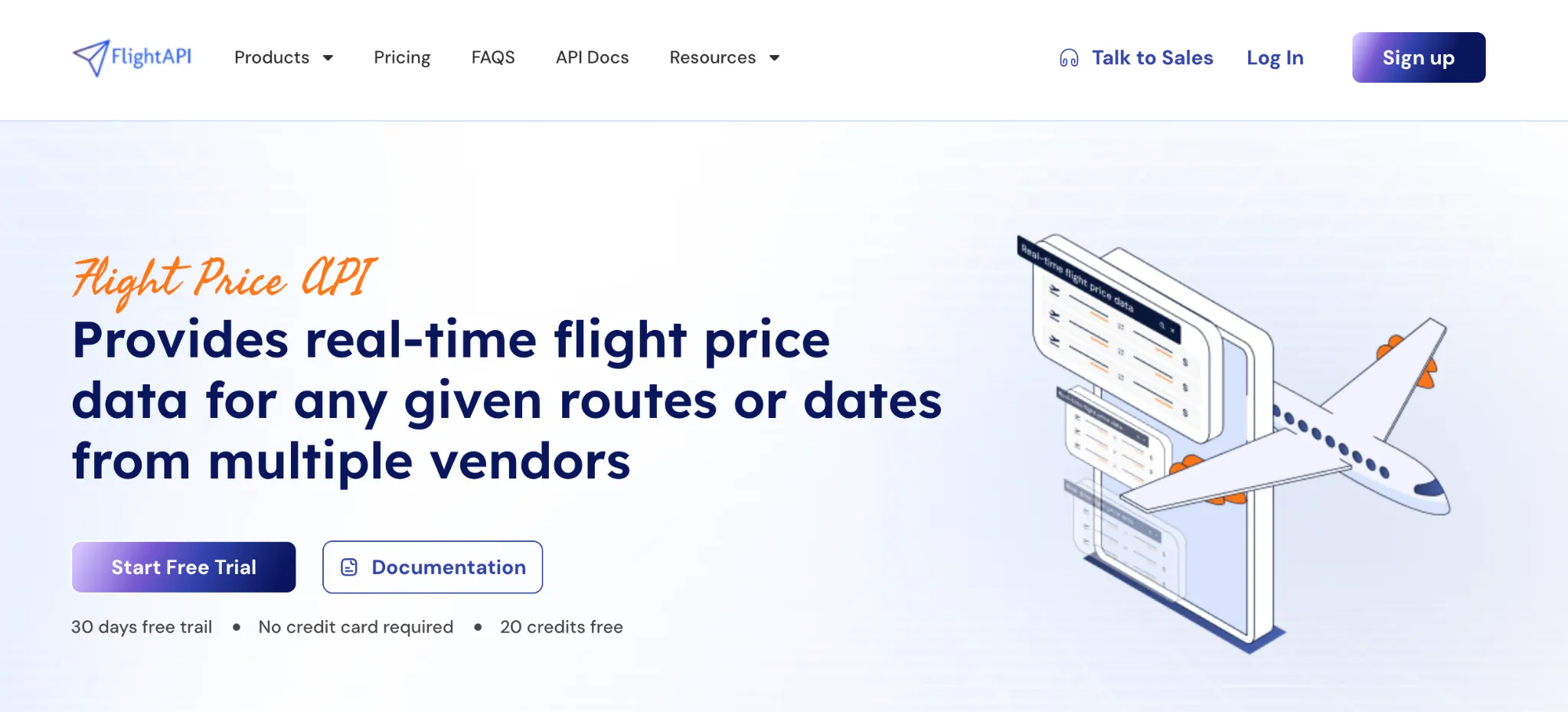
Pros – Its main strength is its reliability. The data it provides is accurate, legal, and stable for production use. With coverage of over 700 global airlines and OTAs, it provides extensive global access to live flight details. The API is well-documented, easy to integrate, and scalable, which makes it suitable for commercial and enterprise-level projects.
Cons: The service runs on a credit-based model, so for heavy use, you’ll need to upgrade or renew your plan on time to maintain access.
2. Google Flights Scraping API
A Google Flights Scraping API works very differently. Instead of using airline or OTA data feeds, these tools simulate a user performing a search on Google Flights, then scrape the web page results to extract flight information.
Services like SERP API and Search API for scraping Google Flights and others do exactly that. They run automated searches, capture the rendered results, and return them as structured JSON. This allows developers to see nearly the same prices, airlines, and schedules that appear on the Google Flights website.
Pros:
Scraping APIs are fast and convenient. They don’t require any official partnerships or integrations, so you can get started immediately with simple parameters (departure, destination, dates, etc.). And, you will get the data available on Google Flights.
Cons:
However, scraping comes with serious downsides. Because it relies on parsing Google’s web interface, even minor design or code changes can break the scraper overnight. Performance can be inconsistent, since Google employs anti-scraping measures such as rate-limiting, IP blocks, and CAPTCHA challenges. As a result, scraper APIs are best for short-term research or small-scale personal projects, not for commercial or large-volume applications.
Conclusion
While the original Google Flights API is no longer available, developers still have reliable alternatives. If you need accurate, real-time, and legally sourced flight data, the Flight Price API by FlightAPI.io is the best long-term solution. For quick experiments or small research projects, a Google Flights Scraping API can work but it’s not suited for production use. Choose the option that best aligns with your project’s scale, compliance needs, and data reliability goals.
Frequently Asked Questions:
Does Google Flights have an API?
No, Google Flights does not have an API. If you’re looking for a Google Flight Search API, consider using a reliable alternative such as FlightAPI.
How can I access the ITA Software API?
The ITA Software API has been discontinued. It’s better to look for another alternative.
Is there any Google Travel API available?
Yes, Google offers travel API. For flight prices, you can explore the Travel Partner Prices API available on the Google Cloud Marketplace. For hotel prices, Google provides the Hotel Prices API, which you can find documentation for on Google Developers. Also, explore a collection of travel APIs for developers in this blog, it includes a wide range of options for your travel data requirement.
What is the Pricing for Google Flight API Alternative?
One viable alternative to Google Flights is FlightAPI, which provides comprehensive flight data and pricing. FlightAPI offers a free trial for new users to explore the platform’s features. After the trial, their pricing starts at $49 per month.
Does Google Flights Have an App?
No, Google Flights did not have a standalone app. It was only accessible through a web browser and has now been discontinued.